
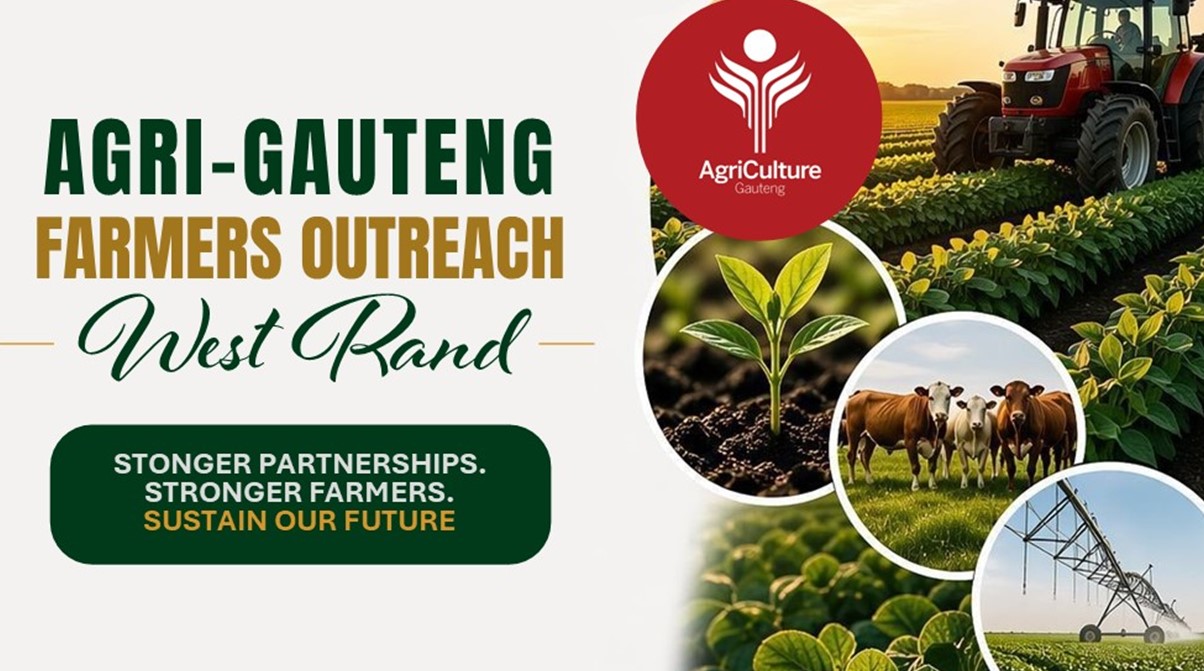
Agri-Gauteng, in collaboration with Mogale City, hosted a farmers’ outreach programme at Mogale’s Centenary Hall this morning, bringing together emerging and established farmers under one roof. The session was aimed at equipping farmers with critical information on how to access support and sustainably grow their agricultural enterprises.
Held under the theme “Stronger partnerships build stronger farmers, ensuring a sustainable future,” the outreach emphasised the importance of collaboration in unlocking the full potential of the agricultural sector. Farmers were empowered with practical insights to help them transition from small-scale to commercial farming, while also supporting established commercial farmers that play a vital role in anchoring production systems and strengthening supply chains.
Although agriculture contributes less than 2% to Gauteng’s provincial GDP, its impact is far-reaching. The sector sustains food security for a population of over 15 million people, supports livelihoods in peri-urban and township economies, and sustains critical agro-food value chains. As South Africa’s primary economic hub, contributing approximately 34-35% to the national GDP, Gauteng relies on a resilient agricultural system to support its consumption and distribution networks.
The programme created a dynamic multi-stakeholder platform where key challenges facing the sector, such as limited access to finance, weak market integration, and fragmented institutional support, were openly addressed. Financial institutions, including Standard Bank and AFGRI, provided valuable guidance on funding opportunities and pathways for farmers to scale their operations sustainably.
Farmers were encouraged to move beyond working in isolation and to actively build partnerships that open doors to broader value chains. Emphasis was placed on the importance of agro-processing and accessing higher-value markets, enabling farmers to move beyond primary production and tap into more profitable segments of the agricultural economy.
The outreach also aligned with the District Development Model (DDM) and local economic development (LED) priorities, reinforcing agriculture’s role as a key driver of regional economic growth. By integrating agriculture into broader economic initiatives, such as the West Rand Special Economic Zone (SEZ) and the Lanseria Smart City development, the sector is being positioned as a catalyst for industrialisation, job creation, and inclusive growth.
As the session concluded, one message stood clear: the future of agriculture in Mogale City lies in collaboration, innovation, and bold ambition. With the right support, partnerships, and access to opportunities, local farmers will not only be able to feed communities, but will build sustainable businesses, strengthen the economy, and shape a thriving agricultural future for Mogale.
Key stakeholders in attendance included MMC for Economic Development Services,Cllr Lwando Resha, Executive Director for Economic Development Services, Nkhangweleni Siliga, Dairy Standard Agency, Indwe, ALZU Feeds, InteliGrow, Gauteng Department of Agriculture and Rural Development, and OBARO.