
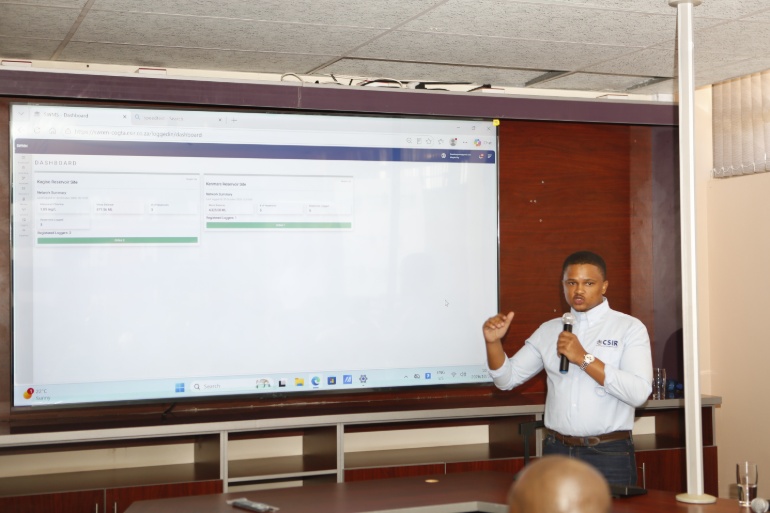
In partnership with the Gauteng Department of Cooperative Governance and Traditional Affairs (CoGTA) and the Council for Scientific and Industrial Research (CSIR), Mogale City on Friday, 30 October, launched the city’s water telemetry pilot project at two reservoirs, marking an important step in strengthening the municipality’s water management capability.
The initiative forms a key component of Mogale City’s Water Conservation and Water Demand Management Strategy (WC&WDM), demonstrating the municipality’s commitment to implementing practical, technology-driven interventions to address water supply challenges and improve the management of its water distribution network.
Importantly, the initiative also comes amid increasing scrutiny of water supply challenges in the municipal area, including the South African Human Rights Commission’s (SAHRC) investigation into water and sanitation-related concerns and the prospect of further action involving government over persistent water supply failures. These developments underscore the urgency of implementing sustainable interventions to safeguard residents’ access to reliable water services. The telemetry project thus represents a tangible intervention in this regard, providing the municipality with improved monitoring capabilities and operational intelligence to address some of the underlying challenges associated with our water supply, infrastructure performance and distribution management.
Building on the work of a joint technical task team convened by the Gauteng MEC for Cooperative Governance and Traditional Affairs to support Mogale City in addressing ongoing water supply challenges, particularly in Kagiso, the pilot has been introduced at the Kagiso and Kenmare reservoirs. The technology will enable the municipality to remotely monitor reservoir levels, water flows and other critical operational indicators in real time. This will provide technical teams with more accurate and timely information to identify emerging problems, assess system performance and respond more effectively to potential supply disruptions.
Beyond addressing immediate operational challenges at Kagiso, the telemetry system is expected to deliver significant longer-term benefits for the municipality’s water management operations, including:
- Improved water supply management as there will be coordinated of water supply during periods of high demand or reduced bulk water availability
- Reduction of water losses and quicker response times to water interruptions
- Saving costs as water resource usage is monitored, tracked and better managed
- Remote monitoring that allows prompt responses and real-time data is shared
- Reduced sight visits as operational information is immediately accessible, and
- Improved accountability and public communication in that operational data is provided to support municipal water supply updates
While the telemetry pilot is an important step forward, the initiative also demonstrates practical steps being undertaken by Mogale City, in collaboration with its government and technical partners, to strengthen water management and respond to concerns relating to the provision of sustainable water services. These interventions contribute towards addressing the broader issues requiring attention through the SAHRC process.
Mogale City acknowledges the significant impact that persistent water supply interruptions have on residents, businesses and communities, particularly in affected areas such as Kagiso. Access to reliable water is fundamental to human dignity, public health and socio-economic well-being.
Therefore, through its Water Conservation and Water Demand Management Strategy, and interventions such as the introduction of telemetry technology, the municipality remains committed to strengthening its water infrastructure management, stabilising the distribution system and implementing sustainable solutions to improve the reliability and efficiency of water supply across the city.